










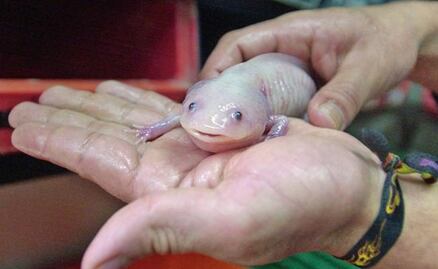
The Ambystoma mexicanum or Mexican Axolotl has the largest genome ever sequenced with 32 billion base pairs , a characteristic that has wondered scientist at the National Autonomous University of Mexico ( UNAM ).
Scientists believe the repeated sequences may help in the treatment of several conditions associated with cancer and aging , thus axolotls giant genome may become crucial in the fight against cancer in the near future.
“It is constituted by a series of identical DNA fragments repeated hundreds of thousands of times. It is a very particular genome composition in which there is little gene density, thus, understanding its organization was a real challenge," explained Felix Recillas-Targa , Director of the Institute of Cellular Physiology at UNAM .
The Axolotl is an amphibian endemic to the lacustrine system of the Valley of Mexico , which has the ability to regenerate both muscle and bone, and even nerves.

It should be noted that it is impossible for the axolotl genome to work in human limb regeneration, yet it is being studied as it may have a possible application in human tissues in the healing process .
Overall, this study examines the physiology of several cellular processes, such as the rate in the formation of cancerous tumors , among others.
sg

Noticias según tus intereses
[Publicidad]
[Publicidad]