


[Publicidad]


Researchers from the National Autonomous University of Mexico (UNAM) designed a new diagnostic test based on saliva samples, which is cheaper, faster, and safer, compared to RT-qPCR.
The first tests were performed in 253 patients from Mexico’s Morelos state, who had to put in a sample cup 2 milliliters of saliva generated in approximately two minutes.
The team of UNAM scientists asserted that this procedure helps reduce risk factors for healthcare workers as they can avoid direct contact with patients who are likely infected since, according to Amnesty International statistics, there are already over 97,632 people who contracted COVID-19 .
“Those who take the sample with a swab from the nose and mouth require more protection for patients usually sneeze or cough and, with each one, the personnel must sanitize, wear another special mask, the protection goggles, gloves, and gown,” warned Mexico’s highest house of studies.
Recommended:
Another benefit of this test , as mentioned by Susana López Charretón from the UNAM’s Biotechnology Institute, is that it is 50% cheaper than the RT-qPCR, which collects samples with swabs from the patient’s nose and throat.
[Publicidad]
The epidemiology expert said there is a shortage of materials to design RT-qPCR tests due to the high global demand, the reason why there must be new methods to diagnose SARS-CoV-2, for performing a higher number of tests will be necessary to end the coronavirus lockdown.
“The problem is that there are increasingly fewer swabs, especially for the nose, so they are now only using the oropharyngeal samples, which reduces by half the collected material for the detection of the virus,” pointed out the also winner of the National University Award 2013 in the category of natural sciences research.
López Charretón mentioned that a good solution will be to test the majority of the civil society for the reopening of companies and schools. “For instance, if we want workers in a factory to resume operations, it would be best to test a representative percentage of them, as Mexico City authorities ask; the same requirements apply to UNAM workers and school-age children” and “ saliva-based [tests] can be an alternative,” she added.
[Publicidad]
This research, which was possible thanks to the collaboration of the Morelos Health Ministry, was published in the Journal of Clinical Microbiology and is available online for those interested in the investigation.
Mexican
researchers are working on the development of serology diagnostic tests in hopes of detecting asymptomatic cases.
[Publicidad]
mp

[Publicidad]
Más información

Amador Narcia
El imbécil de Palacio (2)

Universal Deportes
Yareli Acevedo y la curiosa historia por la que empezó en el ciclismo; ahora es campeona Mundial

Universal Deportes
Yareli Acevedo reconoce que Isaac del Toro “le abre la puerta a más ciclistas que quieran soñar”
Universal Deportes
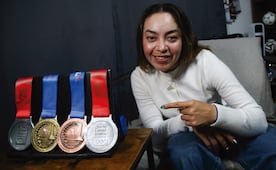
Juegos Centroamericanos y del Caribe 2026, el gran salto en la carrera de Yareli Acevedo