









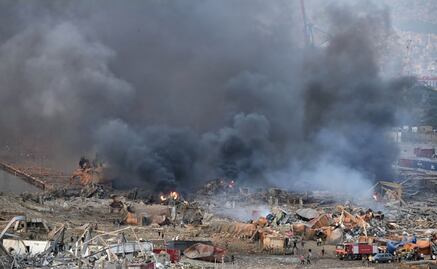
As the dense clouds of smoke dissipated, the magnitude of the disaster became more explicit. Entire neighbourhoods were destroyed, swept away by a blast wave of such massive proportions that it is estimated that more than 300,000 people lost their homes after the blast .
More than a hundred people died and 5,000 wounded increased pressure on a battered Lebanese health system. The health care system was barely getting enough to deal with the COVID-19 pandemic, with its resources already exceeded and in a city that regularly suffers from power outages. During the night, many of the hospitals had to stop caring for the multiple wounded who kept coming because they do not have power plants.
The tragedy in Lebanon is social and economic. Lebanon's economy was already in decline before the explosion and even before the pandemic. The country had been suffering from a financial crisis for years that caused it to stop paying its foreign debt last March. Even before COVID-19, the World Bank predicted that by 2020 more than 50% of Lebanese would fall below the poverty line. The middle class has practically disappeared in what could very soon become a failed state. Millions of people had lost businesses and jobs, and now hundreds of thousands have lost their homes. And sadly, it is not all.
The devastated port of Beirut , under Hezbollah's control, is the supply center for most of the food that enters the country. With the explosion on Tuesday, were lost 85% of the grains stored. According to data released by various media, there would be barely enough to feed the population for a month. Even before the explosion, food prices had increased so much that, in May, inflation increased by 190% in one year.
Plus, all of this is the humanitarian tragedy suffered by Syrian and Palestinian refugees. Lebanon has one of the highest per capita refugee rates in the world, which has fueled internal tensions over its future.
A day later, hunger, tragedy and poverty become even more present. Hundreds of lives were lost, and more than $ 10 billion in economic damage can become the fuel to reignite the protests. Recall that since last year, thousands of people have filled the streets demanding economic and political changes. The explosion will exacerbate all the problems that were already dragging.
The negligence demonstrated with thousands of tons of ammonium nitrate , as well as the suspicion of the existence of a vast warehouse of weapons belonging to Hezbollah, has made many in Beirut speak out demanding an independent investigation. It will hardly be, and it will be even more difficult for them to target the political group openly. However, the future of Lebanon as a nation is also at risk. The humanitarian, social, economic and financial crisis will be unsustainable if the country does not receive foreign aid to tackle its most profound problems beyond its most urgent needs. It is an interesting issue because it will be almost impossible for any nation to help Lebanon, knowing Hezbollah continues as the most important political force.
sg

Noticias según tus intereses
[Publicidad]
[Publicidad]