


Más Información





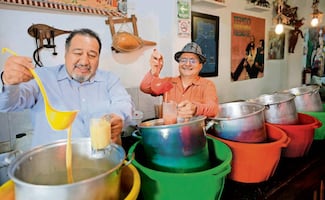

Abigail Mendoza Ruiz, world-renowned Zapotec chef, remembers how her regional dishes were once overlooked by locals: “People now acknowledge regional cuisine, but it hasn’t always been this way, they used to say: “How am I to eat native food!”; for my part I was not afraid to showcase its richness [...] turns out that foreigners acknowledged our regional cuisine first”.
Dressed in the Zapotec fashion and wearing a xlap gitxquiedan, or Zapotec crown braid, on her hair, Ms. Mendoza received the team of EL UNIVERSAL in Tlamanalli, her restaurant located in Teotitlán del Valle, Oaxaca, where she remembers how an article published in Spanish food magazine Gourmet, back in 1991, brought her international acclaim: “They found us through word of mouth as some people from the U.S. had already dined here. At the time, I had an American friend who told me not to build my hopes on them too high since the waiting line for having your article published in Gourmet was exceedingly long. So, a year went by and I finally received the magazine with an article featuring us, I didn’t quite understand what it said, as it was written in English, but that didn’t prevent me to feel really happy”.
In 1993, The New York Times listed Tlamanalli as one of the Top Ten Restaurants in the world, but despite this worldwide recognition, Ms. Mendoza assures that the state government does not provide enough support to promote regional cuisine and prevent this culinary tradition from disappearing:“Oaxaca speaks only through its cuisine, because we do not receive enough support from the state government to continue pushing this culinary tradition forward. Regional cooks need to be heard and made visible, as we want more people in Oaxaca to know of their culinary tradition while, at the same time, reaching all the corners of the world with our cuisine […] in the meantime I work and share my knowledge on our regional cuisine with others”.
Ms. Mendoza developed her fondness for cooking at age five and she proudly tells us how “the first thing I learned was to shuck and shell corn since my parents grew corn and there were always corncobs at hand. I would also learn to soak and cook it in lime water, this we know as nixtamalization, to later grind it in a metate or mealing stone. At first I didn’t like such work, but later, I got excited when I could make my own hand-made tortillas, cactus paddles in pasilla chilli sauce, pumpkin seed pipián sauce and toasted bean sauce”.
Such culinary expertise is frequently passed down from mothers to their daughters, in Ms. Mendoza case, she benefited from her aunt’s knowledge as well, who used to tell her: “Child, I won’t explain what you are going to do, watch and learn”, Ms. Mendoza says that once she was able to make her own chocolate she received heartfelt congratulations on her aunt’s behalf.
Abigail Mendoza never married because she has always set to stay focused and achieve her goals, though she admits that “you never know what might happen later on”. She is not worried about not having children to whom she can pass down her culinary expertise because she will pass it down to all mankind through her cooking book “Dishdaa’w, The life of Abigail Mendoza Ruiz”, dishdaa’w is Zapotec for “the word intertwines with the infinite cuisine”.
“I leave all my knowledge to mankind and future generations who are fond of regional cuisine; this is what I am trying to preserve and revive in my hometown, this is an effort that hasn’t been stopped so far”.

Women cannot hire masons in my hometown
In 1990, Abigail was able to open Tlamanalli, named after the Zapotec good of food, with the satisfaction of being its architect and designer. She recognizes that she had to face some obstacles during the six years it took her to open her restaurant, largely because Teotitlán del Valle is a very traditional village that doesn’t see fit for women to bargain with men; work was left incomplete by the first construction worker she had hired, but later, with her father’s support, she was able to complete her dream business by employing a more “open-minded” mason who was acquainted with her father and came from the capital city.
Before Tlamanalli, Abigail had a food stand at a side of her existing restaurant, since then, she has offered what she considers to be “exotic food” a label closer to the flavor of her dishes than to the selection of ingredients she employs: “The thick nopales, or cactus paddles, we serve are difficult to find for the way in which they are cooked, we also offer Chileagua which is a dish that can be made from yellow chilli sauce and which is cooked inside corn leaves with a wild mushroom filling and pork, chicken or giblets at a side” she notes.
The regional mole, a thick chilli sauce, which she makes using corn, chilli, tomato and Mexican pepper leaf is one her most famous and requested dishes, it was indeed a favorite of chef Bourdain.
Continuous loss of diners
Ms. Mendoza shows herself very pleased with her lifelong achievements, not only in relation to her business but for the benefit of regional cuisine in general. It is with deep regret that she emphasizes how both income and clientele have decreased since 2006, as a result of the lack of steady tourism in the area: “Tourists stopped coming in 2006, with the outbreak of the Teachers’ College crisis, which still takes place in our hometown. The tourism industry has weakened everywhere, not only here and not only due to the Teachers’ College crisis”, this is why Tlamanalli currently operates under a booking scheme only.
“We don’t complain because we can always resort to work in the country and to the production of art crafts, we always keep ourselves busy. Oaxaca is extremely culturally rich and we get to mix that richness with our regional cuisine. I am also a weaver and when I do not tend to my diners I weave a carpet or collect the seeds from the country to produce it; I always keep myself busy”, she adds with a smile on her face.

Noticias según tus intereses
[Publicidad]
[Publicidad]