


[Publicidad]


Today, humanity buys four times as many clothes as it did 20 years ago. The textile industry keeps on growing, despite being the second most-polluting industry in the planet and being responsible for 20% of overall water pollution.
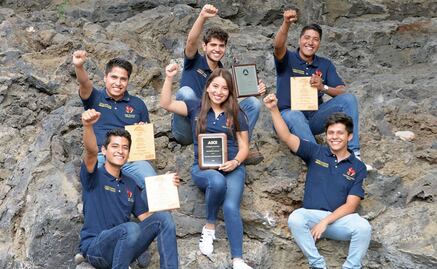
In order to address this issue, four young Mexicans and a Colombian created Bink , a company that dyes clothing with bacteria to save water.
UNAM students Jorge López and Daniela Arriaga
, along with engineers Héctor Sánchez and Luis Méndez, and Colombian architect Carlos Mouriño used their project to participate in DemoDay, an event that allows tech startups to pitch their projects to investors, where they competed against 37 proposals from all around the world.
The world-class panelists chose Bink as the winner of the Global Demo Day 2018 . The winning team won a prize of USD$10,000 , a scholarship to participate in ThinkUp , roadshow with investors and media to accelerate their business idea.
The young participants were also chosen among 30 thousand students from different countries to participate in “ Trepcamp ,” a leading training program for aspiring high-impact entrepreneurs that is held in the U.S., England, and Mexico to support entrepreneurs who aim to tackle global issues.
[Publicidad]
Mexico’s textile industries pollute the equivalent of five olympic-size swimming pools each minute. Textile companies should pay harsh penalties for pouring polluted water down the drain or invest in expensive water treatment facilities. However, this is not the case in Latin America .

Most fabric dyes come from petrochemicals that pollute water with heavy metals. Each process requires at least 2,500 liters of water (550 gallons) , the same amount of water that an average person drinks in three years.
“Plus, they have a negative impact on health. The blue baby syndrome is an example of this and is quite common in Asia. Moreover, many of these materials can cause cancer,” Héctor stated.
[Publicidad]
Though organic dyes could be a valuable eco-friendly alternative, their production process is long and costly. “You can get a green dye from plants, but they take a very long time to grow,” Carlos explained. “On the other hand, it takes 20 to 30 minutes for bacteria to reproduce .”
“We use nano and biotechnology to create an ecological ink by genetically modifying bacteria and reproducing them to further extract different color dyes,” he stated. “We don’t manufacture dyes; we grow them.”
The original idea came from Daniela, who found that a wall in her home kept turning red. She took a sample of the bacteria responsible for the red hue and started cultivating it.
[Publicidad]
Bink competed with other teams from London, Sillicon Valley, San Diego, New York, and Mexico City.
dm

[Publicidad]
Más información

Universal Deportes
América vs Tigres Femenil: Cuándo y dónde ver EN VIVO partido del Apertura 2026

Descubre y Compra
Amazon México: Samsung Galaxy Watch8 con descuento imperdible; ¿por qué vale la pena comprarlo?

Nación
Por humo en estancia migratoria de Chihuahua, INM reubica a 33 personas; atribuye incidente a vandalización de aire acondicionado

Universal Deportes
NFL en México: Se revela la lista de precios para el partido en el estadio Banorte