


Más Información




The wonders of the world are hidden underground. On November 29 , TV UNAM will broadcast a documentary called “El Gran Acuífero Maya” (The Great Mayan Aquifer), which deals with the archeological remains that lie hidden in the underwater chambers of the Yucatán Peninsula.
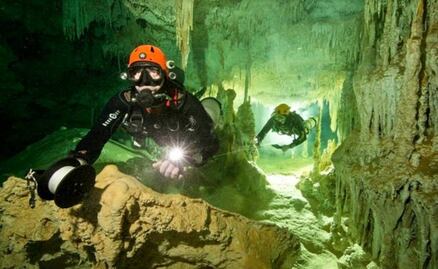
For the last three years, a multidisciplinary team of scientists and archeologists have explored caverns and underwater caves (cenotes) in the Mayan region . The documentary will allow viewers to “untangle the biological and historical secrets that the aquifer has kept hidden for thousands of years,” according to Guillermo de Anda, leader of the Great Mayan Aquifer project .
“The project is meant to disseminate the cultural and environmental importance of these archaeological sites so that people are more acquainted with the aquifer, which sustains many life forms. This is also one of the largest and most important water reserves in the world,” added the investigator from the National Institute of Archeology and History (INAH) .
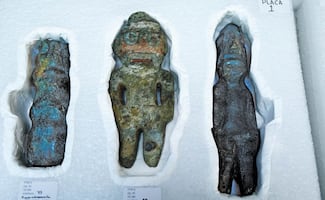
Under the slogan “Mapping the geography of the invisible,” this group of explorers has registered the history and geography of Sac Actún , the largest underwater cave in the world, which is located in Tulum, Quintana Roo . The documentary also tells about the discovery and study of a sunken Mayan offering in the Holtún underwater cave of Chichen Itzá . “Here we found archeological material that has been kept in extraordinary conditions. We have even been able to obtain organic matter kept in a perfectly-preserved condition. The Mayan aquifer is the last great archaeological and paleontological reserve in the territory,” added Guillermo de Anda.
“There are times when people have considered throwing out their garbage in cenotes. Sometimes these underwater caves stand in the way for the construction of new buildings and parking lots, and so they simply cover it up with asphalt, which leads to these wonders being lost. We want to raise awareness on this very important matter,” he commented.
The Great Mayan Aquifer documentary will be broadcast this Thursday at 19:30 hours and repeated on Saturday, Dec. 1, at 16:30 hours . It was produced by TV UNAM and The Aspen Institute, directed by Víctor Mariña, with screenplay by Luis Gallargo . It also had the support of the National Autonomous University of Mexico (UNAM), INAH, the Riviera Maya Institute of Technology, and National Geographic .
According to Guillermo de Anda, the documentary will be used as a pilot of what could eventually become a TV series . “At first, we thought that the project would take us a couple of years, but then we realized that we were wrong; there is no limit. The preservation of this archeological and natural treasure would take several generations,” stated the project director.
dm

Noticias según tus intereses
[Publicidad]
[Publicidad]