


Más Información








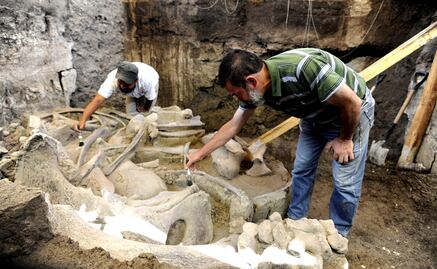
The fossil remains of what is presumed to be a mammoth dating back to the Pleistocene were found in the Puebla municipality.
Last year, members of the Tepalcayotl Association revealed that they had found fossil remains on the Alseseca river during an auxiliary meeting of the San Francisco Totimehuacan community in the state capital.
The finding was made public on Sunday , with the participation of academics from the Meritorious Autonomous University of Puebla (BUAP) .
The remains of a camelid, a dog, a giant wolf, and lithic flakes were also found on the site. Members of the association have claimed that they found more than 132 remains , including mammoth tusks and the remains of a giant wolf.
They also found two molars, a two-meter spine fragment, ribs, and a camelid’s skull.
During a press conference, the specialists revealed that the remains, which are 14 thousand years old, are being kept in a special room by authorities from the auxiliary meeting.
“Totimehuacan is the cultural capital of the state of Puebla. Puebla was founded in Totimehuacan,” they claimed.
They asked the Puebla municipality for support to build a museum where the pieces found in the region can be put on display. They assured that there are more fossils in the Alseseca river.
dm

Noticias según tus intereses
[Publicidad]
[Publicidad]