


Más Información







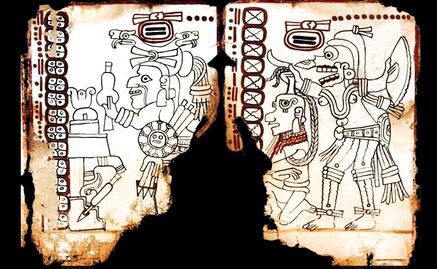
On Thursday, August 27 , authorities from the National Institute of History and Anthropology (INAH) unveiled the temporary exhibition “Códice Maya de México. Eslabón, fuente y testigo” ( Mexico’s Mayan Codex. Link, Source, and Witness ), giving visitors the chance to contemplate the oldest legible manuscript in the history of the American continent.
In addition to the document, cross discipline analyses conducted between the years 2017 and 2018 were added to the exhibition with the purpose of illustrating the legitimacy of the historic object.
The anthropologist Diego Prieto commented that, ever since its first public appearance at the New York Grolier Club in 1971 and until August 30 last year , when INAH ratified its authenticity, the Mayan Codex of Mexico (often called "Grolier Codex") had only been accessible to a small number of specialists in the field.
At the museum premises, all 10 sheets of the pre-Hispanic manuscript , which is usually kept in the codex vault of the National Library of History and Anthropology (BNAH) , were put on display in a linear sequence.
In a press release, INAH commented that the Engineering Faculty of Mexico’s National Autonomous University (UNAM) built an anoxic capsule which was injected with argon gas to prevent the proliferation of microorganisms and keep humidity levels stable for the exhibition.
The capsule is 5.7 feet tall and was designed exclusively for the codex, which dates back to the Early Postclassic period (900-1200 AD) . The historic object was placed in a safety showcase to be monitored constantly.
The exhibition museography was divided into five modules and developed with a historic, cosmogonical, and scientific approach, featuring technology resources accessible to all visitors.
The general director of INAH, Diego Prieto Hernández , attended the opening of the exhibition in the framework of the 29th International Anthropology and History Book Fair (FILAH) .
The exhibition will continue until October 28 at the Museum of Anthropology in Mexico City Tuesday through Sunday, from 09:00 to 19:00 hours .
dm

Noticias según tus intereses
[Publicidad]
[Publicidad]