


[Publicidad]


A group of academics from the University of Guadalajara (UdeG) have warned that a lack of translators is one of the main challenges facing the rescue of indigenous languages in Mexico.
“We need more interpreters and translators,” stated Gabriel Pacheco Salvador, an investigator from the University Center of Humanities and Social Sciences (CUCSH) of the UdeG and coordinator of the Indigenous Literatures of America Award .
He mentioned that, unlike Spanish, English, French, and Chinese , indigenous languages do not possess such a robust and consolidated methodology.
“We need to train potential translators or hire professional ones in large numbers,” he assured, recalling that 2019 was the International Year of Indigenous Languages .
Through a press release, the UdeG pointed out that 25.69 million Mexicans (21.5% of the country’s entire population) are part of an indigenous community, but only 7.38 million can speak an indigenous language , according to a survey conducted by the National Institute of Statistics and Geography (INEGI) in 2015 .
Pacheco Salvador explained that most existing translations were made thanks to the National Institute of Indigenous Languages (INALI) , though he regretted that said task was not replicated in other states of the republic.
[Publicidad]
“One national institute is not enough to permeate all states, which is where most of these languages are spoken,” he underlined.
The head of the Indigenous Languages Department at the UdeG, José Luis Iturrioz Leza , pointed out that, although public authorities had produced radio and television material in indigenous languages, as well as several versions of the Constitution and calls for competitions, there are still not enough professional translators in said sector.
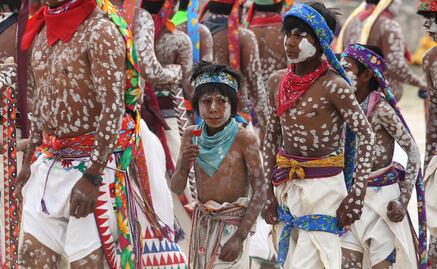
Contrary to popular belief, wixárika is not the only indigenous language spoken in the state of Jalisco.
[Publicidad]
“In Guadalajara , there are entire quarters with different ethnic groups from indigenous communities. Such is also the case in Mexico City, Hermosillo, Tijuana, Chicago, and Los Angeles . They are everywhere,” he stressed.
The University of Guadalajara is organizing translation workshops with people from eight different indigenous communities, including the Mixe, Zapotec, and Wixárika peoples .
dm
[Publicidad]

[Publicidad]
Más información

Universal Deportes
Serie del Rey: Cuándo y dónde ver EN VIVO partidos entre Toros de Tijuana y Olmecas de Tabasco

Estados
Pescador sobrevive 8 días a la deriva frente a Oaxaca; Armada de México lo rescata con vida

Tendencias
¿Quieres tu versión de los 80s?; aquí te damos el paso a paso para pedírselo a Gemini
Nación
Sedena informa de operativo bilateral antidrones en frontera México-EU; operación inició el 31 de agosto