


Más Información






In the middle of the jungle, about 12 meters underground , archeologist Sergio Grosjean Abimerhi and his team found what could be the most important cave paintings discovered in the state of Yucatán so far, due to the great richness of the images “which show the advanced development of the Mayan culture.”
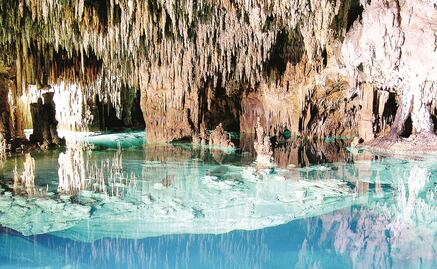
The paintings are engraved in a rock of approximately 15 meters long and 5 meters tall within a cave that was found in the western part of the state of Yucatán, in south-east Mexico , near a small blue water cenote (underwater cave).
“These are not the only cave paintings in Yucatán, but they are surely the most important because they feature many interesting elements: Birds, mammals, a cross, geometric figures, human shapes, warrior shapes, and several hands of different shades ,” stated the investigator in an interview with EFE . Sergio Grosjean Abimerhi is also a documentary adviser for National Geographic, Discovery Channel, and BBC , as well as several Japanese and Spanish firms.
In other communities of Yucatán, such as Homún, Kaua, and Akil , several petroglyphs have been found which are often hard to decipher, but “account for the Mayan culture’s high development. These new findings are no exception,” stated the director of the Mexican Institute of Ecology, Science, and Culture , which was founded to conduct both cultural and environmental research in the country.

This new discovery will allow for the archaeological team to know more about the Mayans’ customs, “although we still don’t know what these images mean or from what period they date, they are the most important that we have ever seen.”
“We cannot reveal the location of the archaeological site at this moment because, regrettably, tomb raiders and thieves are always one step ahead of us in Yucatán,” he claimed.
Grosjean stated that, in order to study the meaning of the paintings, researchers will take photographs and, with the permission of local authorities, hope to implement a sustainable project so that visitors can access the site, generating jobs for local inhabitants.
The archaeologist has dedicated 20 years of his life to environmental care , and he assures that there are over 3,000 cenotes in Yucatán that hold Mayan treasures and ornaments , though many of them have been ransacked.
Grosjean believes that Yucatán has the potential to become the world’s underground mecca, generating thousands of jobs and preventing water pollution in the region.
“I hope that the upcoming administration authorities will have the same vision and make use of Yucatán’s cultural and natural potential which is unfortunately beginning to disappear at an alarming rate due to tomb raiders and looters.
dm

Noticias según tus intereses
[Publicidad]
[Publicidad]